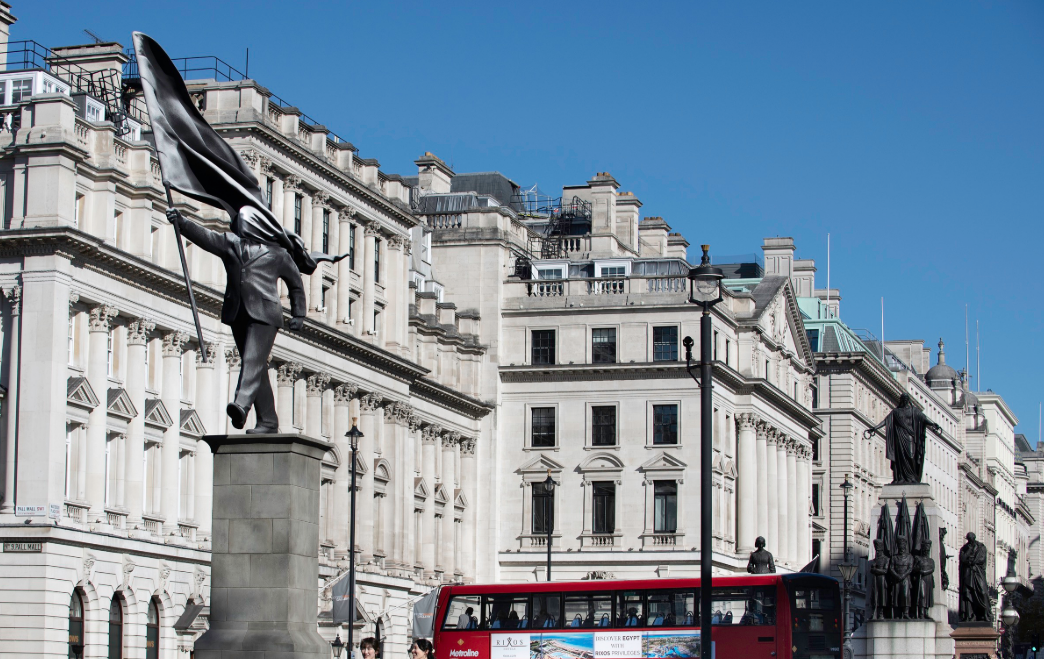
Banksy’s public interventions in London continue to challenge the boundaries between street art, political protest, and monumental sculpture. At the end of April, the anonymous artist once again attracted international attention by installing a large plastic sculpture in Waterloo Place, St. James’s — a prestigious location near Pall Mall and Carlton House Terrace in Westminster. Surrounded by monuments dedicated to Edward VII, Florence Nightingale, and the Crimean War Memorial, the new Banksy statue immediately established itself as a provocative commentary on history, nationalism, and political power.
As with many of Banksy’s projects, the installation appeared almost effortless despite its logistical complexity. According to witnesses, the operation involved a low-loader truck, several traffic cones, and a small, anonymous team working with remarkable speed and coordination. A person wearing protective goggles was reportedly seen securing the sculpture onto the plinth with lifting equipment while traffic continued to flow through the busy London district. The entire process lasted only minutes, reinforcing Banksy’s reputation for carrying out ambitious public actions with minimal resources and maximum visual impact.
The political meaning behind the sculpture
The political symbolism of the sculpture is difficult to overlook. The work depicts a businessman dressed in a formal suit, carrying a large flag as though participating in a patriotic march or political rally. However, the fabric of the flag covers the figure’s face, blinding him as he unknowingly steps toward the edge of an abyss.
The message strongly reflects Banksy’s criticism of contemporary geopolitical tensions and the growing radicalization of nationalist ideologies around the world. The sculpture suggests that modern political movements often lead societies toward conflict and self-destruction while leaders remain blinded by ambition, propaganda, or ideological obsession. In this interpretation, the businessman becomes a metaphor for governments and nations moving toward instability without recognizing the consequences of their actions.
Placed in one of London’s most historically symbolic public spaces, the sculpture also creates a dialogue with Britain’s imperial legacy and modern political identity. The work resonates particularly strongly at a time of increasing global polarization, military conflicts, and deteriorating international relationships.
What will happen to the new Banksy statue?
Unlike some of Banksy’s smaller street works, the scale of this installation makes theft highly unlikely. Comparisons have already been made to Banksy’s 2004 sculpture “The Drinker,” which disappeared after being stolen and resurfaced years later. However, the new Banksy statue has already gained widespread public attention and remains under close supervision.
Although Westminster City Council confirmed that the installation had not been officially authorized, public reaction from local authorities has generally been positive. London mayor Sadiq Khan and other officials acknowledged the sculpture’s cultural significance, while temporary fencing and monitoring measures were quickly introduced to protect the artwork as discussions about its future continue.