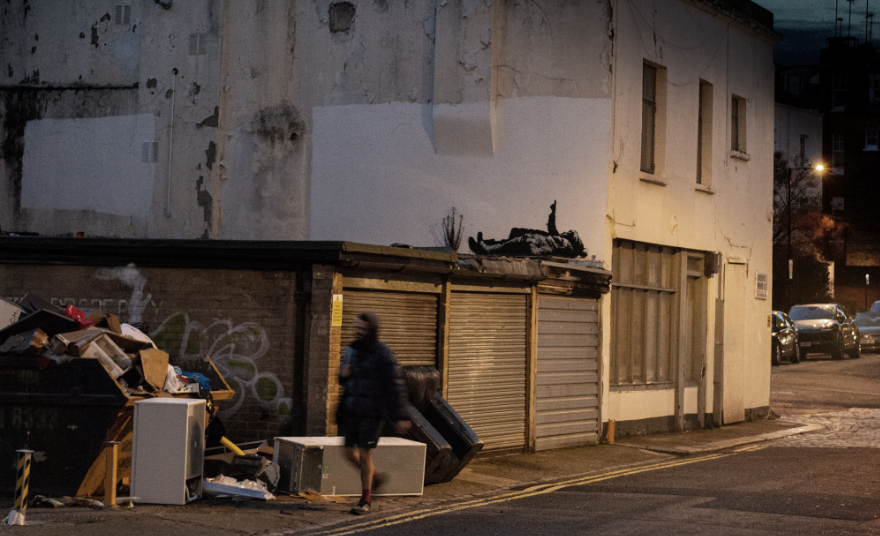
Less than two years have passed since the moment Banksy decorated the streets of London with a fancy animal series of stencil murals, and the capital of Great Britain is again in the spotlight of street art lovers. This time, it is a new street art mural that appeared on a wall in west London above the garages on Queen’s Mews in Bayswater. Banksy officially confirmed his authorship on his Instagram account, making this new spot a popular highlight.
New street art mural by Banksy
The mural has no official name thus far, but it depicts two children, dressed in warm winter clothes, lying on the ground and watching the sky. The older child is pointing at something with a finger as if teaching the smaller one something or trying to show some object. When the mural is viewed at night, the visitors may get a feeling that children are stargazing. This street art mural was created in two copies in London, with the second one appearing outside the Center Point Tower in central London. Banksy hasn’t yet confirmed the authorship of the latter.
What is the meaning of “Stargazing Children”?
As usual, Banksy’s street art evokes lots of speculation about the hidden meaning and agenda. This time, experts have recollected the artist’s frequent use of children’s images in his murals and have referred to Oscar Wilde’s words about people looking at the stars, linking children’s imagination and belief in magic with their ability to step beyond the routine and see the beauty of the world.
Other interpretations link the children pointing at stars with the Star of Bethlehem, seeing the Christmas topic in the mural. Yet, there are some satirical analysts as well, who suggest the possibility of Banksy’s reference to artificial lights of the megapolis in his stencil art. If the Star of Bethlehem is linked to artificial lights, one can see the false promise in the message, with the sacred being gradually replaced by the routine and functional in human lives. This view is consistent with Banksy’s earlier critiques of branding and consumerism that substitute genuine feelings and relationships among people.
Finally, some critics view the stencil as a reference to child homelessness, a serious problem across the globe. Each of these interpretations holds meaning, especially in the light of Banksy’s earlier critical murals on the suppression of pro-Palestine protests. Thus, the stencil’s true meaning remains open to speculation, as always with Banksy’s art.