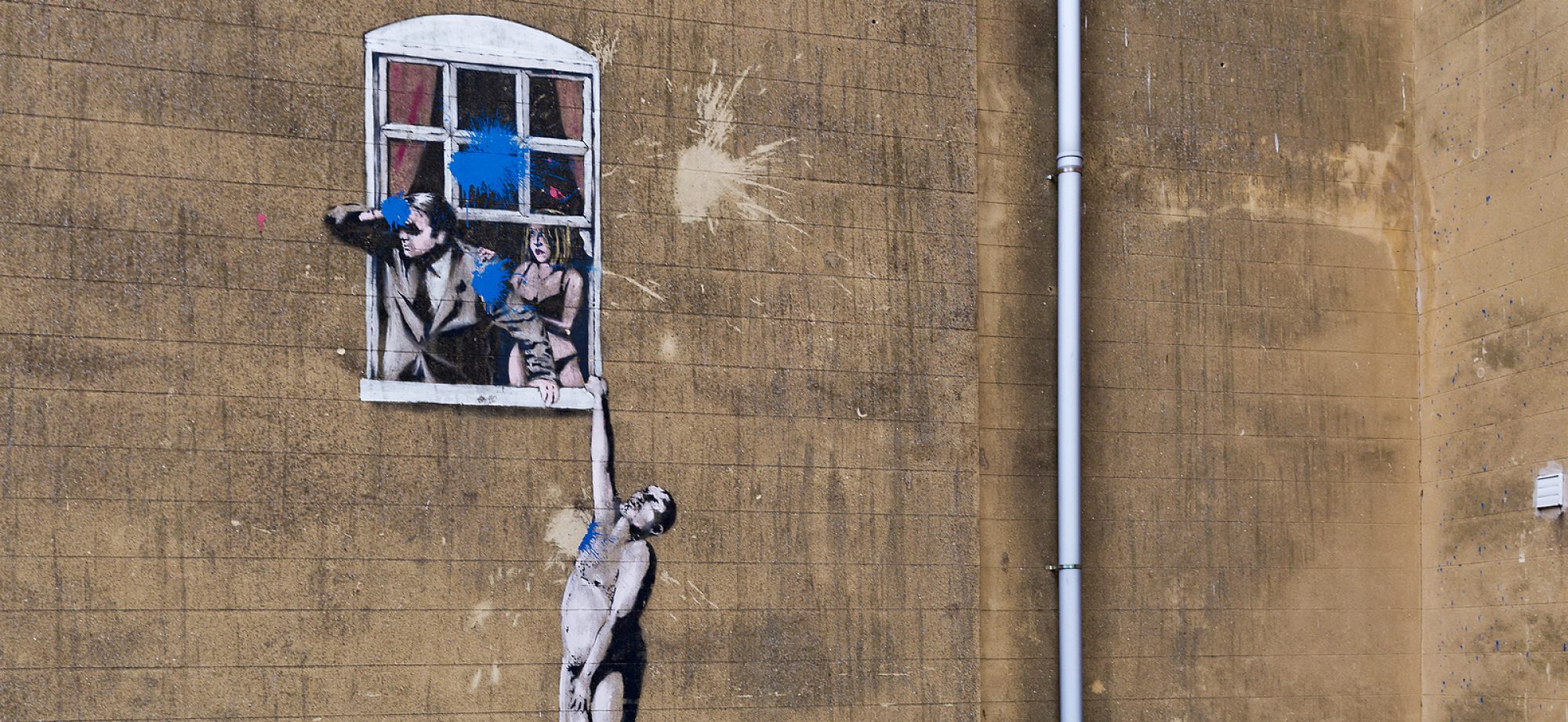
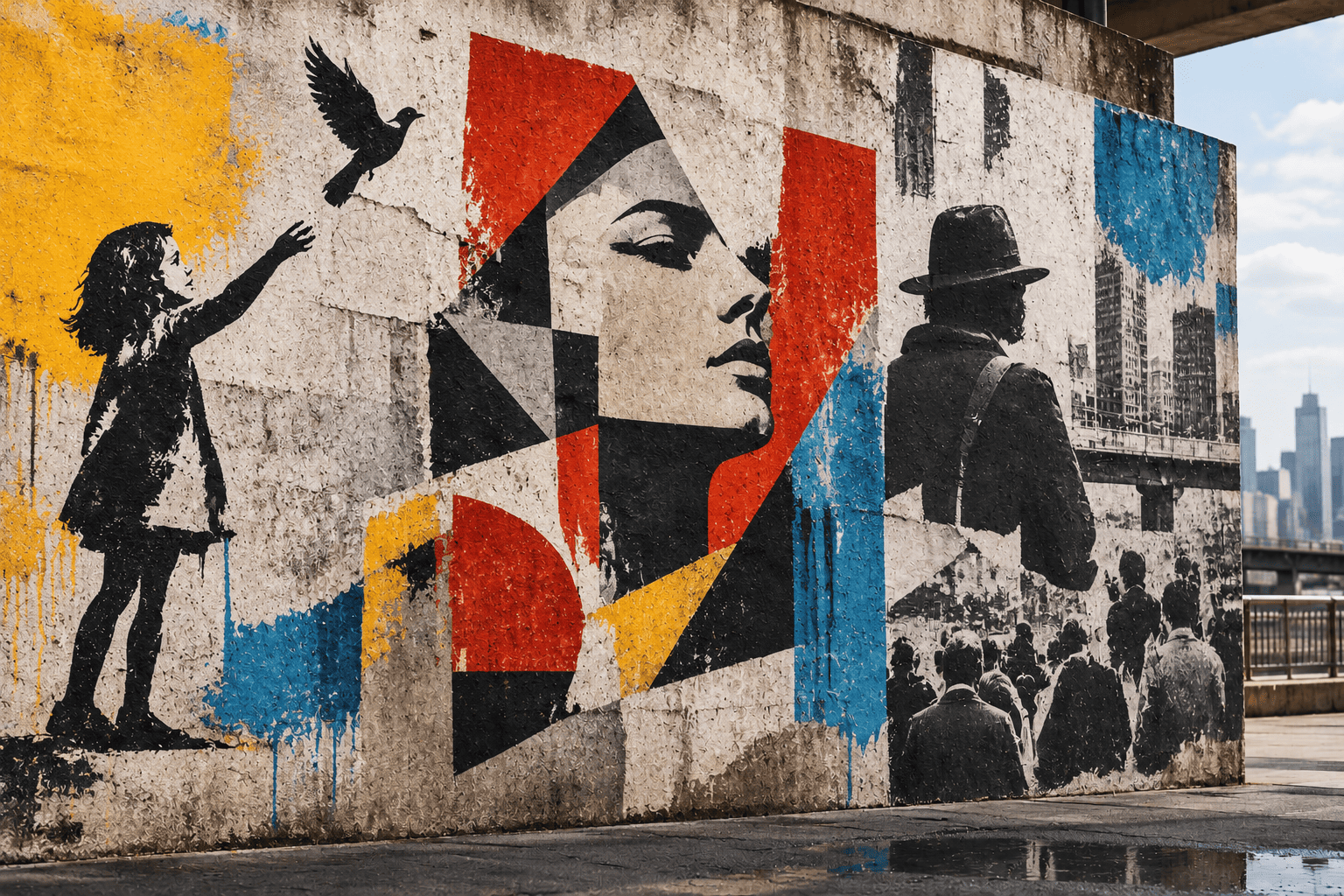
Banksy’s artistic formula is easy to recognize: crisp stencils, dry political humor, anonymity, and public artworks that appear overnight. However, this approach did not emerge in isolation. Other street artists helped shape the visual language of the movement, while developing their own approaches to public space and social commentary. Three artists like Banksy share some elements of his artistic DNA while taking their work in fundamentally different directions.
Three artists like Banksy the world should know
Blek Le Rat: a pioneer of stencil art
If Banksy’s work has a notable predecessor in stencil art, it is Xavier Prou, the Parisian artist known as Blek le Rat. In the early 1980s, he began spraying stenciled rats onto city walls, later expanding his work to include life-size human figures. His murals share visual similarities with Banksy’s art, including the use of stencils to create recognizable images quickly. Banksy acknowledged the resemblance, famously noting that Blek had produced similar ideas years earlier. However, Blek le Rat’s work often takes a more poetic approach, while Banksy is widely known for his pointed political and social commentary.
Shepard Fairey: propaganda as a brand
Shepard Fairey emerged in the street art scene in the late 1980s with his Andre the Giant Has a Posse sticker campaign, which evolved into the OBEY project. His similarity to Banksy lies in his use of powerful visual symbols, propaganda-inspired graphics, and mass advertising imagery to challenge established ideas and power structures. However, Fairey works publicly under his own name and has created commissioned works alongside independent street art. His HOPE portrait of Barack Obama became an iconic image during the 2008 US presidential campaign, demonstrating how street art and graphic design can influence political communication.
JR: the semi-anonymous artist
JR is a French artist known for his monumental photographic installations and distinctive public persona, often recognized by his hat and sunglasses. Like Banksy, he has used public art to address political and social issues. Both artists have also created works connected to the separation barrier between Israel and the West Bank: Banksy painted murals there in 2005, while JR developed his Face 2 Face project in 2007.
Their methods, however, differ significantly. JR uses large-scale photographic portraits pasted onto walls and other public surfaces, often involving people from the communities featured in his work. His projects emphasize human identity, dignity, and connection. Banksy, by contrast, frequently uses fictional characters, familiar symbols, and irony to communicate his messages.
Each of these artists deserves a place on a list of artists like Banksy. Their distinct approaches demonstrate how street art can challenge conventions, engage communities, and transform public spaces into platforms for creative expression.