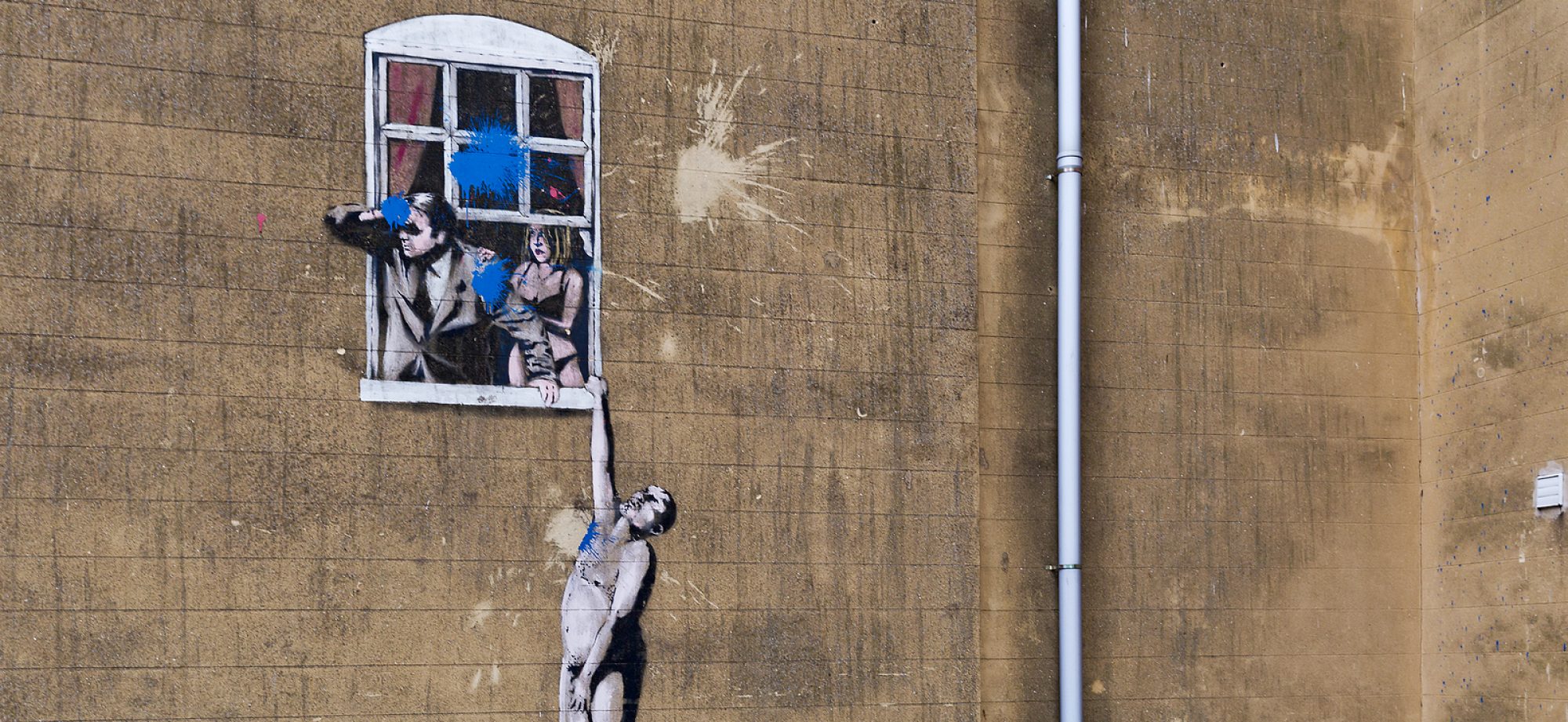
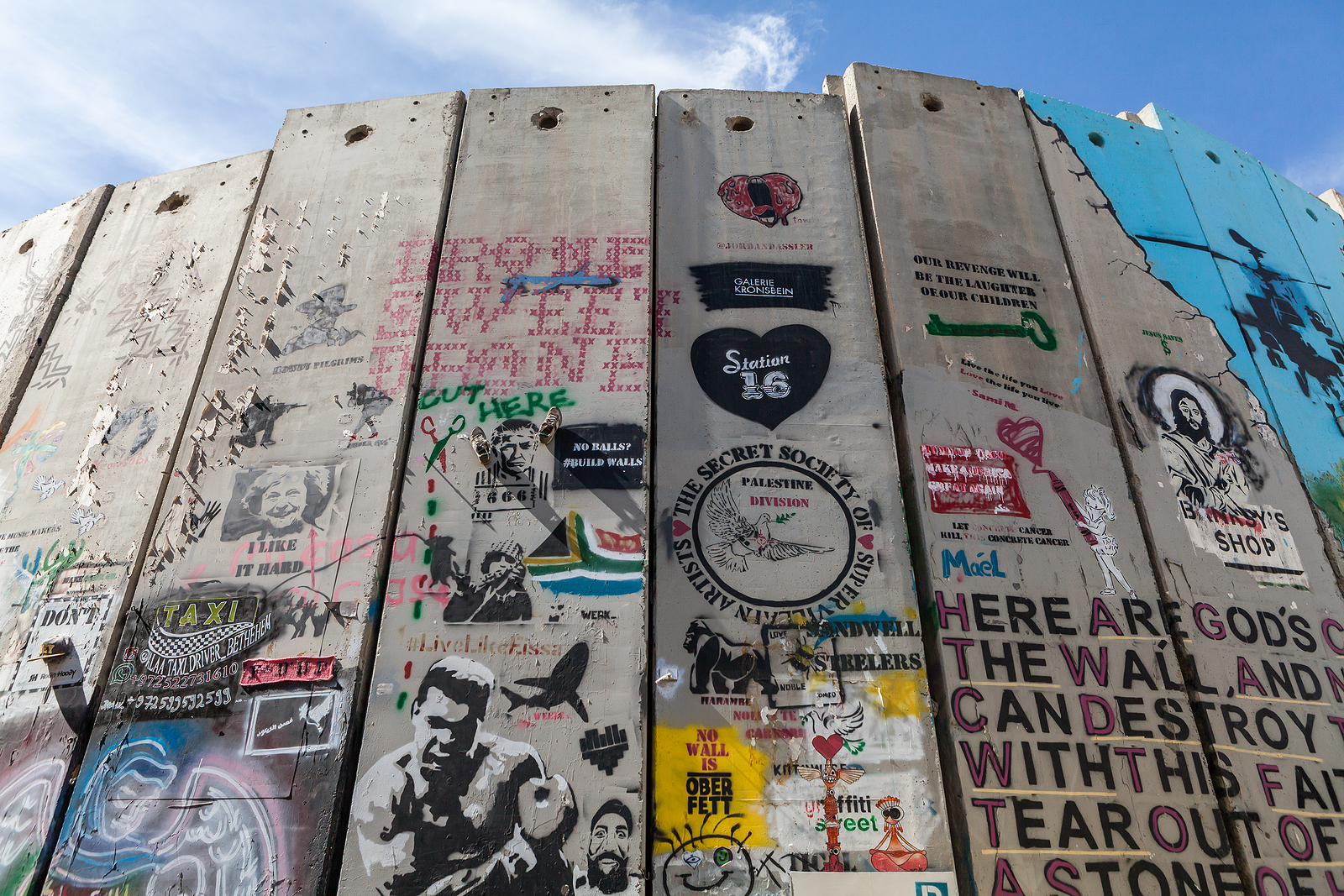
Street art is controversial by definition in many cases. Murals appear in public places, often without permission, to share rebellious ideas and dissent. Still, some controversial art pieces attract more debate than others for political, cultural, or legal reasons.
Political provocations
One of the most common sources of controversy around street art is explicit political messaging and criticism of local or international political forces. For instance, in 2005, Banksy painted a series of murals along Israel’s West Bank barrier. Many viewers saw an in-depth message about the consequences of confinement in his works, while others criticized the artist for simplifying a complex political conflict.
Offensive, harmful images
There is always a thin line between critique and personal bias or prejudice in controversial art pieces. An illustrative example is the 2012 mural Freedom for Humanity by Mear One. It appeared in London’s East End, depicting bankers playing a Monopoly-like game on the backs of laborers. The mural was ordered to be removed by local authorities after critics argued that its imagery contained antisemitic tropes. The artist insisted that the mural was a critique of class and the power of bankers, and the case took on a clear political dimension.
Ownership and commodification
The basic premise behind street art is its presence in public spaces, but the high-end art market sometimes treats it as a collectible commodity. Banksy’s Slave Labour mural disappeared from a building wall in North London in 2013, later reappearing at auction. Residents of the district protested, arguing that the mural was Banksy’s gift to the local community. The artwork was eventually sold at auction despite the controversy. Street artists also protest against the commodification of their work. For instance, Blu famously painted over his own murals in Bologna in 2016 after some of his works were removed from buildings for a museum exhibition without his consent.
Legality and artistic rights
Apart from the issues discussed above, the long-standing debate over street art as vandalism or a distinct form of art is far from resolved. These tensions complicate legal questions surrounding street art, as demonstrated by the case of 5Pointz. The Queens complex had been covered with street murals for years with the owner’s permission before the works were whitewashed overnight ahead of the site’s demolition. The artists sued the owner and ultimately won, with a federal court finding that 45 works were protected under the Visual Artists Rights Act.
Why dealing with controversial art pieces is hard
These cases illustrate many sides of one problem: street art occupies public spaces but does not necessarily belong to the public. It may instigate debate and cause backlash. Its legal status is continually tested and challenged, while questions of ownership, artistic freedom, and commercialization can produce very different outcomes.